


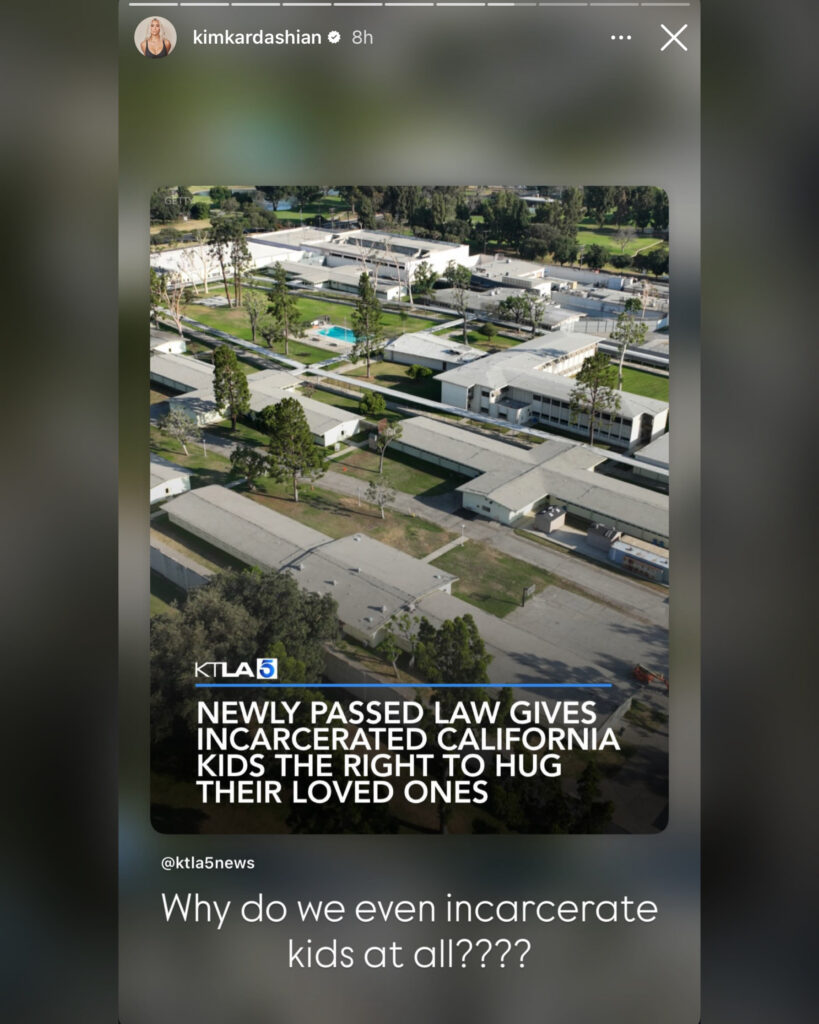
Reality star and criminal justice reform advocate Kim Kardashian is brining some attention to California’s newly enacted juvenile justice legislation this week, using her platform to raise a broader structural question: “Why do we even incarcerate kids at all????”
RELATED: Spotify Shares Surge After Signing Kim Kardashian For Criminal Justice Podcast
The comment, posted to Kardashian’s Instagram story alongside a news report on Assembly Bill 1646, reframed the public debate surrounding California’s “Hug Act.” Signed into law by Gov. Gavin Newsom, AB 1646 makes California the first state in the nation to establish a statutory right for youth in juvenile detention facilities to engage in consensual physical contact such as hugging and hand-holding with visitors. Under the new law, physical contact cannot be arbitrarily denied or used as a blanket disciplinary measure. Facilities may only restrict physical contact if an immediate safety threat exists, and any limitations must be formally documented.
While the legislation has been celebrated as a milestone for juvenile rights, Kardashian’s reaction pointed out a lingering tension in the reform movement, she questioned the very premise of locking up children, though she offered no alternative framework for housing, rehabilitating, or disciplining youth accused of serious crimes.
More:
The origins of the legislation trace back to the youth housed inside the facilities. Two years ago, during testimony by the Urban Peace Institute, advocates presented a poster crafted by youth at Los Padrinos Juvenile Hall detailing ten basic requests. The final item read: “We want to hug our moms.”
In response, Los Angeles County Supervisor Janice Hahn partnered with incarcerated youth to champion the issue. Young people inside the facilities assisted in drafting the statutory language, creating campaign artwork, and submitting letters of support marking the first time incarcerated youth have directly helped write state legislation in California.
The law also addresses long standing policies in county facilities where physical touch had been restricted or entirely banned. Family members described the severe emotional toll of those restrictions; one mother reported receiving a three-week visitation ban simply for hugging her son on his birthday.
The bill faced pushback during legislative debate. Probation officials and law enforcement representatives raised security concerns regarding contraband smuggling, citing a 2023 fatal fentanyl overdose at a Sylmar facility and multiple 2025 security incidents at Los Padrinos that resulted in hospitalizations. Los Angeles County probation officials estimated that supervising contact visits would require additional staffing costs of approximately $1 million.
Supporters countered that AB 1646 balances security and rehabilitation by maintaining facility authority to impose documented, targeted restrictions during verified security threats, rather than enforcing facility wide bans.
Socialites, how do you feel about this? Sound off in the comments box below!