

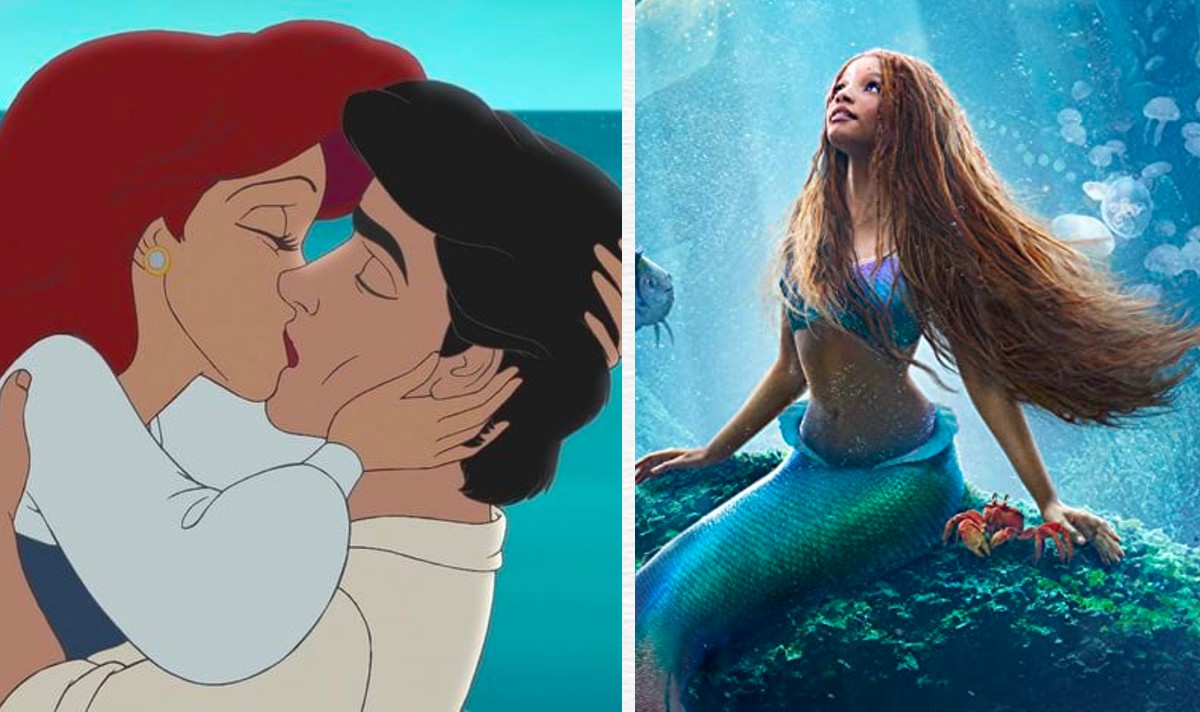
Songs lifted from the upcoming “The Little Mermaid” live-action remake have reportedly been updated to include consent so that people aren’t offended by the lyrics in tracks such as “Kiss The Girl.” In an interview with Vanity Fair, the film’s composer Alan Menken confirmed that there have been some changes made to the classic songs to avoid any backlash from people who may feel offended by Prince Eric “forcing” himself onto Ariel. “There are some lyric changes in Kiss the Girl because people have gotten very sensitive about the idea that [Prince Eric] would, in any way, force himself on [Ariel],” he told the publication.
If you’re familiar with the original 1989 Disney film, while the song “Kiss The Girl” is being sung, Prince Eric is encouraged to kiss Ariel before it’s too late — but he never actually asks her for consent. The lyrics include, “Yes, you want her. Look at her, you know you do. Possible she wants you too. There is one way to ask her. It don’t take a word. Not a single word. Go on and kiss the girl.” And given how sensitive people have gotten, it seems as if Disney wants to avoid facing any scrutiny that could come their way by not altering the lyrics to not just that song but several others.
View this post on Instagram
Menken continued to add, “We have some revisions in Poor Unfortunate Souls regarding lines that might make young girls somehow feel that they shouldn’t speak out of turn. Even though Ursula is clearly manipulating Ariel to give up her voice.” Menken is said to have teamed up with producer Lin-Manuel Miranda to rework some of the original songs we’ve all grown up to love, so if you catch yourself noticing some lyric changes, it’s seemingly to avoid the movie being targeted by cancel culture.
Bailey’s casting has also faced backlash from some who argue that the role should have gone to a white actress. These individuals claim that the original character was white, so therefore, the actress should be white as well.
However, this argument ignores the fact that The Little Mermaid is a fictional character who can be played by anyone. Additionally, this argument perpetuates the belief that white actors are the default, and that actors of color should only be cast in roles that are explicitly written as non-white.
The arguments against Bailey’s casting are flawed for several reasons. Firstly, they ignore the fact that The Little Mermaid is a fictional character, and therefore, can be played by anyone.
Secondly, they perpetuate the belief that certain roles can only be played by white actors, which is both limiting and harmful. Finally, they ignore the importance of representation and diversity in media. By casting Bailey in the role, Disney is taking a positive step towards greater representation and diversity in Hollywood.
View this post on Instagram
The lack of diversity in Hollywood is not a new issue. Hollywood has a long history of marginalizing people of color, both in front of and behind the camera.
For years, Hollywood perpetuated the “white savior” trope, where white characters would come to the rescue of people of color, reinforcing the notion that white people were superior and needed to save those who were “less fortunate.”
Additionally, Hollywood has been criticized for perpetuating negative stereotypes of people of color, such as the “angry black woman” or the “lazy Mexican.” These stereotypes are not only harmful but also limit the opportunities for actors of color to play nuanced and complex roles.