

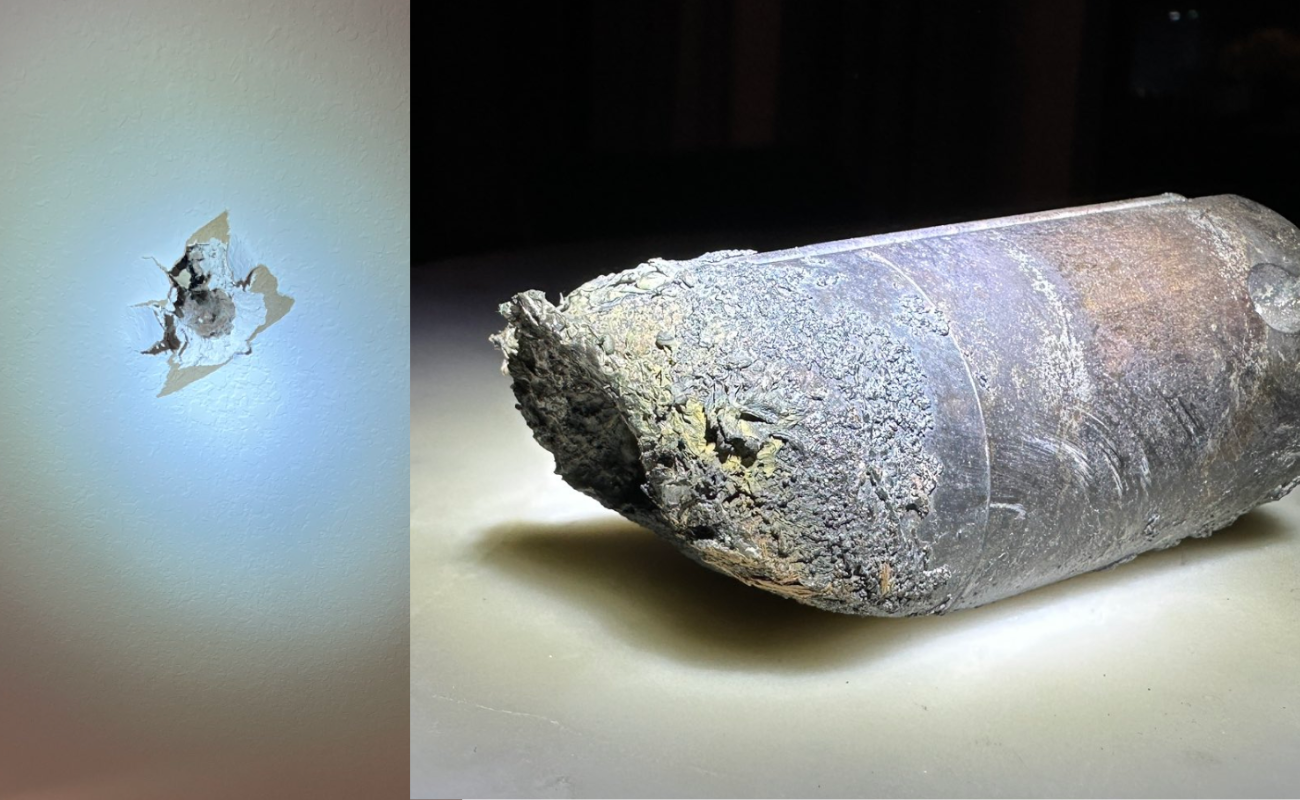
NASA is currently investigating a significant piece of metal, believed to be from a discarded International Space Station (ISS) battery pallet, plummeted through a home in Naples, Florida, causing extensive damage. The incident occurred on the afternoon of March 8, when the cylindrical metal object weighing around 2 pounds crashed through two residence levels.
RELATED STORIES: NY Inmates File Lawsuit Over Prison Lockdown During Solar Eclipse
Alejandro Otero, the homeowner, recently experienced a shocking incident where an object crashed through his house and created a loud noise. Although he wasn’t present at the time of the event, his son narrowly escaped harm as he was in a nearby room. According to scientific sources, including Ars Technica, the debris is believed to be from the International Space Station (ISS). This claim is further supported by the US Space Command’s tracking of space debris that was re-entering the Earth’s atmosphere over the Gulf of Mexico and was headed towards southwest Florida, which coincides with the timing of the crash captured by Otero’s home security system, as reported by The Guardian.
Josh Finch, a spokesperson for NASA, communicated to Ars Technica the agency’s efforts to analyze the fragment to ascertain its origins swiftly. Meanwhile, space experts are leaning towards a specific source for the debris. NASA had previously announced the jettison of a 2.9-tonne battery pallet from the ISS in March 2021, marking it as the heaviest object ever discarded. This pallet was expected to re-enter the Earth’s atmosphere in an uncontrolled descent around the time of the incident.
RELATED STORIES: Tropicana Las Vegas Closes Its Doors: Historic Casino to Be Demolished
Jonathan McDowell, an astronomer at Harvard-Smithsonian, had noted that while most of the pallet would burn up upon re-entry, approximately half a tonne of debris could reach the Earth’s surface.
Otero, seeking accountability for the damage to his home, has contacted NASA without a response. The ownership and responsibility for the debris are complex, given the battery’s association with NASA and the pallet’s connection to a launch by the Japanese space agency, JAXA. The European Space Agency (ESA) had also been tracking the pallet’s descent, noting the low risk it posed to individuals despite the potential for debris to make ground contact.
ESA highlighted that uncontrolled re-entries of large space objects are a weekly occurrence, with most fragments burning up before posing a risk. The design of space hardware often incorporates measures to minimize the dangers associated with re-entry, underscoring the rare nature of incidents like the one experienced by Otero.