

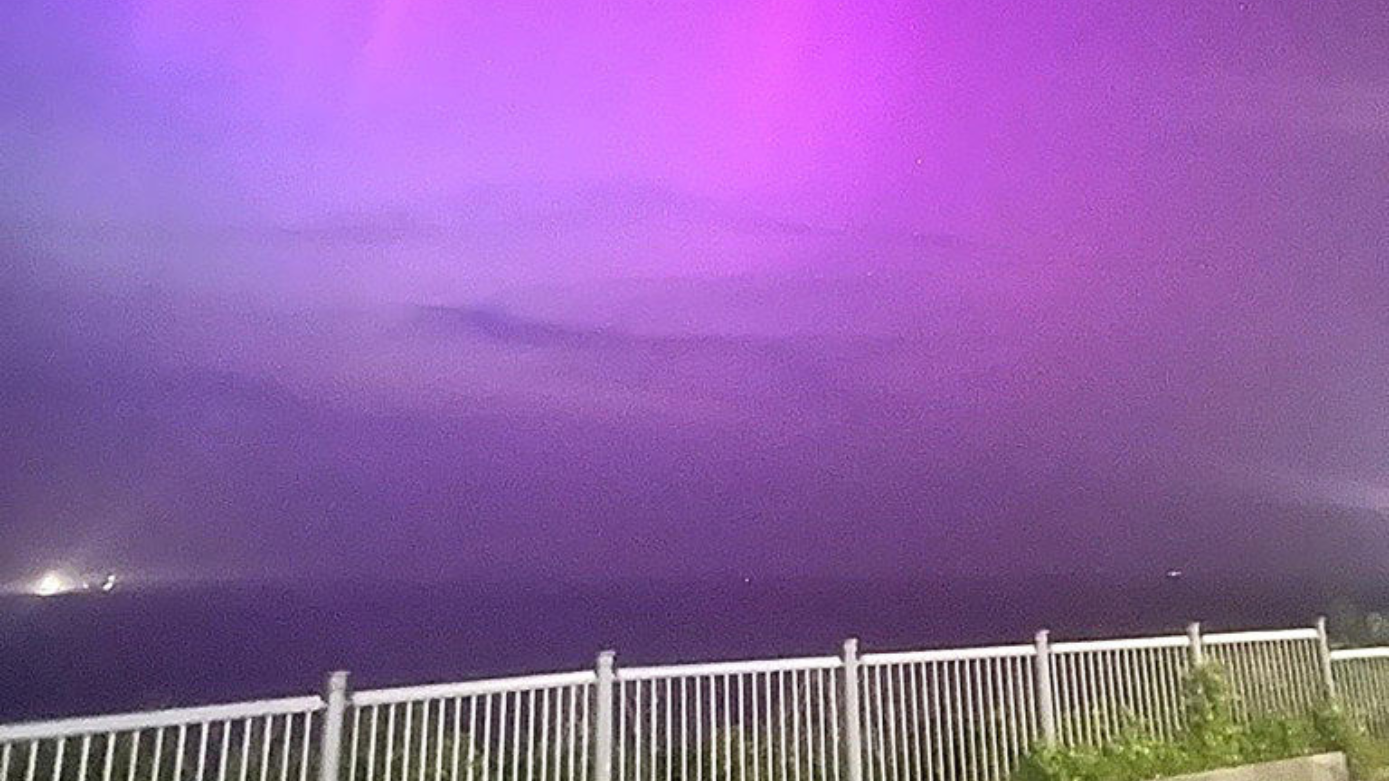
The National Oceanic and Atmospheric Administration(NOAA) has issued an updated alert, escalating a geomagnetic storm to Level 5, the most severe classification on their scale. The G5 storm, which started affecting Earth just before 7 p.m. on Friday, is the first occurrence of such intensity since the Halloween geomagnetic storm of 2003.
RELATED STORIES: Tropical Storm Hilary: DoorDash Temporarily Suspends Operations In Southern California Communities
During that time, significant disruptions were recorded, including power outages in Sweden and damage to transformers in South Africa. According to NOAA, a G5 geomagnetic storm can lead to “widespread voltage control problems” and “protective system problems” and the risk of complete collapse or blackouts in grid systems. The storm has also triggered a Level 6 K-index forecast through Saturday evening. The indicator measures disturbances in the Earth’s magnetic field from 0 to 9, suggesting potential impacts to the power grid at latitudes north of 55 degrees beyond the United States. Additionally, technologies such as GPS systems and satellite navigation might be affected.
This rare geomagnetic disturbance is also set to offer a stunning visual display, as the northern lights, also known as aurora borealis, will be visible as far south as Alabama, the New York Post reported. The phenomenon, which is usually seen closer to the poles, will be observable across much broader regions of the U.S., providing a rare opportunity for residents to see nature’s light show.
RELATED STORIES: Oh No! Lovers & Friends Festival 2024 Canceled Due to ‘Dangerous Weather’
Social media users also reacted to the storm news and hoped to see the aurora borealis in their hometowns. “Nashville! Go outside and look up. Believe it or not, the aurora borealis will be visible tonight. Wild to see the Northern Lights clear down in Tennessee,” one user wrote. Another said, “upper half of the usa + uk get aurora borealis meanwhile, my a** in florida gets to stare up at the mood illuminating all the mosquitoes and storm clouds so gorg.”
Geomagnetic storms erupt when the Sun throws out a powerful surge of charged particles called a coronal mass ejection (CME). These eruptions can carry billions of tons of plasma and a southward-oriented magnetic field. When a CME slams into Earth’s magnetosphere, the planet’s magnetic shield, it can cause a chain reaction. The solar wind’s pressure can squeeze the magnetosphere, while the southward magnetic field can merge with Earth’s own, funneling energy deep into the atmosphere. This surge of energy supercharges the particles trapped in Earth’s radiation belts, leading to a geomagnetic storm. The storm’s intensity depends on the strength of the CME and how well its magnetic field aligns with Earth’s.